
Zohra’s Faith and Samas’s Philosophy
The Reincarnationist PapersConversations in the Moroccan home put religious faith, remembered experience, pleasure, and responsibility side by side without making the disagreement disappear.
increasing Bearing strength in each event
 decreasing
Bearing strength in each eventdecreasingA Muslim Home
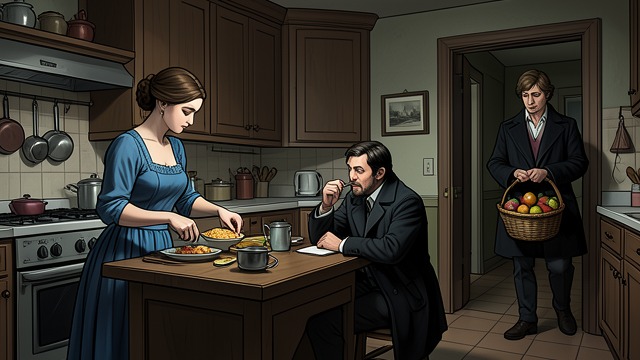
A Muslim Home
A household shaped by faith
Zohra’s home and religious practice reflect a life organized around Islam. She prepares food for her household and for people in Rabat, treating service as an ordinary part of belief.
A different outlook beside it
Samas shares the home while holding to an Epicurean philosophy rather than religious faith. Their coexistence makes belief a lived relationship, not an abstract debate.
A contrast for Evan
Evan sees that a member of the Cognomina can love someone whose beliefs differ sharply from his own. The household complicates any easy assumption that remembered reincarnation must lead everyone to the same philosophy.
Samas Defines Pleasure

Samas Defines Pleasure
Experience over doctrine
Samas argues that the life immediately available is made of meals, conversations, relationships, and ideas. For him, those experiences carry more certainty than promises about an unseen afterlife.
Pleasure as attention
His emphasis on enjoyment does not reduce to wealth alone; it includes art, food, travel, and companionship. He treats pleasure as active participation in life rather than a reward postponed until later.
A philosophy offered, not proved
Samas presents his view confidently, but Evan remains uncertain. The conversation places a practical philosophy beside religious faith without resolving which account of existence is true.
Poppy’s Anger at Religion

Poppy’s Anger at Religion
Guilt as a social force
Poppy argues that religious systems teach people to restrain desire through guilt and promises of salvation. She sees this as a way people avoid responsibility for their current lives.
Experience as counterevidence
She treats the Cognomina’s repeated lives as evidence against a single-life moral system. In her view, returning without karmic reward or punishment exposes the limits of doctrines about moral accounting.
Anger beside insight
Her argument reflects genuine disappointment and a desire to challenge the life she believes people have been taught to accept. Its force is also personal: she speaks from accumulated memories, not detached theory.
Zohra Answers with Faith

Zohra Answers with Faith
A distinct answer
When asked about belief, Zohra identifies herself as a Sunni Muslim. Her concise answer stands apart from the long arguments offered by Poppy and Samas.
Conviction without debate
Zohra does not need Samas to share her faith for it to remain meaningful to her. Her certainty is personal, while his laughter at the difference exposes how differently they interpret the same question.
Coexistence rather than victory
Their marriage shows that philosophical disagreement need not be resolved by conversion or defeat. The novel leaves Zohra’s faith intact alongside Samas’s experience-based worldview.
Responsibility Without Absolution

Responsibility Without Absolution
The question of wrongdoing
Evan asks whether members are evil for displacing earlier lives and whether Samas’s theft of valuables from the dead was justified. He is searching for a moral framework that does not rely on a divine judge.
Samas accepts the burden
Samas argues that he must answer for his actions without outsourcing blame to a god. He calls the capacity for evil part of their nature and says that freedom requires recognizing the darker self.
A difficult form of freedom
The exchange does not make wrongdoing harmless. It proposes responsibility, rather than absolution, as the only way to live with choices that memory preserves.
When Evan arrives in Morocco
During dinner with Evan and Zohra
During the Zurich dinner conversation
At dinner in the coastal home
During Evan’s conversation with Samas at the art collection
